Friday, June 8, 2012

Dana Air crash and allied matters


CHUKS OLUIGBO

One thing the Dana Air crash on June 3 brought to the fore is the failure of the Nigerian system. As someone rightly said, it was not only Dana that crashed; it was the entire Nigerian structure. But in spite of this completely broken down structure; in spite of dilapidated – and, in many cases, non-existent – infrastructure in many parts of the country; in spite of housing deficit running in the neighbourhood of 16-17 million; in spite of putrefying corruption in every department of the establishment; and in spite of abject, absolute poverty of the greater majority in the midst of plenty all over the land, you still hear the nation’s leaders waxing lyrical about Nigeria being the greatest nation in black Africa, about the economy being the third fastest growing in the world, and about a phantom dream of being among the top twenty most developed economies in the world in 2020. It's funny really – and sometimes, it draws tears from my eyes.

Indeed, each time government speaks on any national issue with those tongue-in-cheek blandishments, each time a member of the federal executive council comes up with those bamboozling rhetoric, it makes me think that either our leaders are taking all of us for fools, or they simply can’t see beyond their nose. Take the issue of Boko Haram. Since the attacks began, the presidency has continued to mouth the same promises, mantra-like – “We’re on top of the situation”, “We’ll fish them out”, “We’ll get to the bottom of the matter”, “We’re battle-ready”, etc – reminiscent of the Nigerian Police vowing to get the killers of Bola Ige and bring them to book.

Unfortunately, everything now follows a routine that even children in the kindergarten can predict it: An attack occurs somewhere in the north; the president comes out to condemn the attack; next he visits the surviving victims in the hospital; next he condoles with the families of those who lost their lives; and then he vows to fish out the perpetrators. Then we all go to sleep and wake up the next morning to hear of another attack in Kano or Kaduna or Bauchi. The president comes out again to perform his regular ritual, and the story continues.... That’s why I agreed with a friend who once asked: “Everyday the president vows, the president pledges, the president promises – pray, when will the president act?”

While one must concede that there has been relative relief from the BH attacks in the last one month to the last attack in Bauchi on June 2, it is pertinent, however, to remind the president that Nigerians have not forgotten his promise that Boko Haram would end in June. Or, will it also be consigned to the incinerator alongside numerous other previous promises? June is here, and we are counting.

One other thing, our government seems to have a penchant for circumventing issues instead of tackling problems head-on. It reminds me of a certain mad man who once said that the solution to Nigeria’s problems was to rewrite the National Anthem and change the design of the flag. Solution indeed! But, truly, successive governments have not thought any differently. Case study: Sometime not too long ago, it was in the news that President Jonathan was urging the National Assembly to enact stiffer laws and recommend stiffer punishments against examination malpractice and cultism in schools. I thought about it and I said: Why will you make a new legislation? I know there is an existing law on exam malpractice, and I also know that I’m yet to hear of anybody who has been prosecuted or jailed for exam malpractice since that law was enacted. So, why not first ask why nobody has been brought to book on the basis of the existing law? That would have led us to the key issue of enforcement, which analysts agree is the matter, and not the non-existence of laws. But someone up there thinks the problem is with the existing law and so recommends its amendment. Maybe when amended, the new law will implement itself. Who am I to argue?

Now Dana Air has crashed, killing 153 people on board, plus numerous other innocent people into whose residence the ill-fated aircraft crashed. First, it was disappointing that at the time of the incident, no television station in the country bothered to air it, giving room for speculations and panic messages in the social media platforms. When I raised the issue, I was told that the stations were only obeying the Nigerian Broadcasting Commission (NBC) regulation. Well, for whatever reasons, showing cartoons or a football match or any other programme at such a time when the nation was in panic and sorrow smacked of insensitivity. Perhaps it is time to review the NBC regulation.

Following the crash, a number of things have happened. One, the Federal Government in its usual reactionary manner seems to have woken up from slumber and now considers it wise to probe into the activities of the regulatory agencies and airlines operating in the industry. It has also ordered thorough investigation into the cause of the air mishap and has vowed, as usual, that all those found culpable would be made to face the music. We still await action on the various reports already submitted on other issues since the inception of this administration and for which the president made similar pledges. The government, which has issued more condolences than any other message in the last one year, has also condoled with the families who lost loved ones in the crash.

Two, people in relevant quarters whose tongues were tied by corruption before the accident are now speaking up, but it’s all like flogging a dead horse. The dead are dead and gone. No amount of probes, revelations and sanctions in this world can wipe the tears of the bereaved.

And now to the counterfactuals: What if the accident hadn’t happened? The government wouldn’t have looked into what the regulators are doing; the regulators would have continued to neglect their oversight functions on the airlines; airline operators would have continued to overlook safety and aircraft maintenance issues; the tongues tied by corruption would have remained tied; and airliners like Dana would have continued to fly caskets in the name airplanes; and the tragedy, when it would have occurred, would have been graver than what we saw on June 3. God forbid! So, the accident was a big lesson and an eye-opener after all, though it came at a great cost – loss of precious lives that would have been saved if the right people had done the right things at the right time.   

Finally, as I watched “former” Reuben Abati of the fiery pen standing beside his boss, the president, at the crash site, probably crafting the presidential condolence message in his mind, I imagined how many articles he would have churned out from this singular incident and the kind of adjectives he would have used to qualify the crass negligence of duty that led to this avoidable tragedy; that is, if it were still in those days when “economic strife and gain” had not beclouded “the fine things of the mind”, to use the words of the great philosopher Will Durant. But that too is one of those sad realities of the Nigerian situation. May the souls of the dead rest in peace!

Thursday, March 8, 2012

Cassava: The Route To Food Self-sufficiency In Nigeria

By Chuks OLUIGBO

“External food dependency is the most pernicious form of national insecurity,” wrote Onwuka Njoku, a frontline professor of economic history, in his book, Economic History of Nigeria in the 19th and 20th Centuries. Without doubt, any nation that relies on other nations for its major food supplies puts itself at a great risk. This is why a nation like Nigeria must strive to achieve self-sufficiency in food production.


Cassava farm

Nigeria is an agriculturally-endowed nation. Leading economic historians agree that agriculture was the mainstay of the traditional economies of the various peoples of Nigeria in the pre-colonial and colonial periods. Up to the early 1970s, agriculture accounted for well over 80 percent of Nigeria's Gross Domestic Product (GDP) and the major value of the country's exports.

That was before the oil boom era. With the oil boom, Nigeria had the opportunity to build up its agricultural sector with the petro-dollars accruing from the oil sector and transform Nigeria once and for all into a food-sufficient economy – as did countries like Indonesia, Malaysia, etc. Regrettably, the government of the day frittered away that chance and instead embarked on a spending spree on white elephant projects. Consequently, Nigerians gradually abandoned agriculture and everybody faced crude oil. Petroleum became the pivot around which the nation’s economy revolved such that today, any quake in that sector has adverse negative effects on the whole economy.

With the passage of time, successive governments seemed to have realized the mistakes of the past and so made efforts (even if half-hearted) aimed at redirecting Nigerians to the farms. Such agricultural programmes as the River Basin Development Programme (RBDP), Operation Feed the Nation (OFN), Green Revolution (GR), the Directorate for Food, Roads and Rural Infrastructure (DFRRI), the Better Life for Rural Dwellers Programme (BLRDP), among others, were initiated. Specifically, OFN was launched against the background of alarming decline in agricultural production, galloping food prices, increasing food import bills, and accelerating flight of youth from the rural to the urban areas. Unfortunately, the programme yielded no positive dividend except that the huge sums mapped out for it ended in private pockets. Its successor, Green Revolution, was also an abysmal failure and created greater problems than it came to solve.

In order to solve the problems created by GR, the government in power embarked on unprecedented importation of rice, wheat, and other food items through a Presidential Task Force. Overnight, Nigeria, which used to export food to other countries, became one of the world's highest importers of food items, and consumer goods topped the list on Nigeria's import records. That situation has continued to worsen with the passage of time. For instance, a 2011 report from US Wheat Associates Inc., a trade group for the world's largest exporter of wheat, projected that Nigeria would soon displace Japan as the biggest buyer of United States' wheat. Already, Nigeria is the world's largest rice importer. Currently, according to the Minister of Agriculture, Akin Adesina, Nigeria’s food imports are growing at an unsustainable rate of 11% per annum, fuelling domestic inflation and driving poverty. “We are importing products that we can either produce in abundance – such as N356 billion worth of rice, N217 billion worth of sugar, and N97 billion worth of fish – or are importing products that we can easily find local alternatives for us to reduce our import bill, such as N635 billion being spent on importing wheat.”


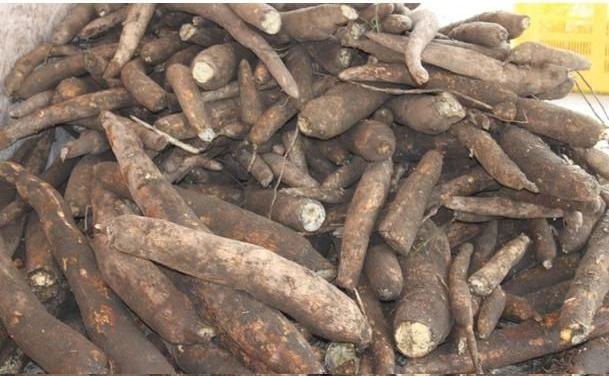
Harvested cassava tubers

Perhaps it was against this backdrop that President Goodluck Jonathan on November 30, 2011, introduced the cassava bread initiative as a component part of the Cassava Transformation Agenda. While presenting a sample cassava bread (made from 60 percent wheat flour and 40 percent cassava flour) to Nigerians at the Federal Executive Council meeting, the president said: “I have been eating this bread for the past one week and I will continue to eat only this bread until I leave State House. We must encourage what we have. Other countries that became great did not wake up one day and become great. If you look at the history of a country like China, at a time they closed their door and restructured everything, began to think again and by the time they opened their doors, the rest is known by all of us. For us as a nation to move forward, we must also tame our exotic taste. Some of these things we bring from outside are not even as good as what we even have within our country. And I believe with this, so many of the people who produce bread will start to use different percentages of cassava flour.”

He was right on point as through the new initiative, bakers in Nigeria are expected to supplement wheat flour with 40 percent locally-produced cassava flour in bread. The president has also shown some seriousness by following up the initiative with bold fiscal policies in the 2012 budget. These include raising the tariff on imported wheat, ban on importation of cassava flour, zero taxes on all equipment and machinery for processing high quality cassava flour and composite flours, 12 percent tax rebate for all producers of high quality cassava flour who attain the 40 percent substitution with high quality cassava flour, etc, which will take effect progressively. The government has further invited four major bakeries in the country – Wilson Foods and Confectionery Limited, Leventis, Food Concepts, and United Trading Company (UTC) Nigeria – to spearhead the production of cassava bread and other cassava flour-based confectionery.

Already, some stakeholders in cassava production are embracing the idea. For instance, the Association of Small Scale Agro Producers in Nigeria (ASSAPIN) promised to cooperate with the Federal Government to increase cassava production to complement government’s efforts. Also, the Federal Institute of Industrial Research, Oshodi ( FIIRO), Lagos, is already producing cassava bread in commercial quantity, beginning with only 10 percent cassava flour inclusion, which will be increased progressively until the 40 per cent target is achieved.

Others, however, are still skeptical given their bitter experience with such programmes in the past. Recall that in July 2002, the Obasanjo government inaugurated the Presidential Initiative on Cassava, which made compulsory 10 percent inclusion of cassava flour in wheat flour production, 10 percent blending of ethanol with premium motor spirit, and the use of cassava starch by industries. The initiative was expected to boost local industries involved in the processing of cassava products, generate about $5 billion annually via exports, and create employment. Farmers across the nation embraced it, and it also stirred the interest of entrepreneurs in cassava processing firms. But then, at the level of implementation, the initiative died, and both farmers and processors who embraced and invested in it with the hope of benefitting from its numerous advantages were left aground to count their losses. 


Adesina: Agric minister
 
The above fact does not, however, diminish the gains of a policy like the present one, most important of which is leading the way in Nigeria’s drive towards internal food-sufficiency. If cassava succeeds, attention can be shifted to other food crops like rice. Already, cassava is cultivated in every part of the country in very large quantities and, from statistics available from the Raw Materials Research and Development Council, Nigeria is the world’s largest producer of cassava, with a production capacity of 49 million metric tons – about 19 percent of world production. Nigeria can leverage on this comparative advantage, as did even smaller cassava-producing countries like Thailand, which capitalized on an export-led growth to become a major processor of cassava and exporter of cassava products, mainly to European Union countries. Today, Thailand is the world's largest processor of cassava – 40 million tonnes a year – mainly into vegetable starch.

But for this to work in Nigeria, government must device how to tackle the challenges currently faced by cassava farmers in the country such as lack of access to high yielding varieties, limited access to appropriate cassava processing technologies, and highly volatile price swings for cassava due to poorly developed markets; get the bakers to cooperate with government; build storage houses where cassava will be stored before it is transported to milling factories; convince consumers that cassava bread is as good as wheat bread; increase government’s budgetary allocation to agriculture from its present 2 percent; among others.

Finally, the government must be firm in implementing this policy, which has been described as “a make or mar policy that if well superintended could kick-start the liberation of the country from the woods”. I conclude with the words of Dupe Olatunbosun, professor of agricultural economics and former chairman of Ogun State Cassava Revolution Programme, thus: “The present administration should resist the blackmail of the wheat importers, majority of whom are the elite in the society. Nigeria will not collapse. It was Pandit Nehru, first prime minister of India, who said after India’s independence in 1948 that if India could not produce enough textiles to clothe its teeming population, she should go naked. Indian textile mills roared into action, churning out millions of yards of various designs of cloths. He also said if India could not feed herself, it was more honourable to die than to be dependent on another country before Indians could eat. That was the beginning of Indian grand agricultural industries.” This is the path Nigeria must toe if the current cassava initiative must succeed, and if the long-term dream of internal food-sufficiency must be achieved.

Tuesday, March 6, 2012

Okorocha dissolves Imo town union excos … As 4th tier govt election holds April 19


Ahead of the 4th tier government election billed for April 19, 2012 in Imo State, the state governor, Rochas Okorocha, has dissolved the executives of thea 357 town unions across the 27 local government areas of the state. 

When fully operational, the 4th tier government will attract unprecedented development to communities in the state, making Imo the most developed state in the country.

During a breakfast meeting with traditional rulers in the state at the Ahiajoku Centre, New Owerri, the governor said he dissolved the town union excos to pave way for a level playing ground for all the intending aspirants in the forthcoming election.

He urged Imolites interested in contesting for the available posts – president-general of community, community speaker, women leader, and youth leader – to kick-start their campaign, noting that Option A4 system of voting will be adopted for the polls.

While stressing that all traditional rulers in the state are expected to reside in their communities, Governor Okorocha directed all Imolites in the state government-owned primary, secondary and tertiary institutions to submit their names through a form to their traditional rulers who will then forward same to the government through the Ministry of Local Government.

Wednesday, February 22, 2012

Okorocha Denies Allegations Of Money Laundering

Okorocha: Imo State governor


Imo State governor, Owelle Rochas Anayo Okorocha, has described as unfounded the rumour peddled by some people that he was arrested in London by Metropolitan Police for money-laundering.
 
Gov Okorocha, who stated this while speaking with journalists at Sam Mbakwe Cargo Airport shortly on arrival from Abuja, said the rumour was orchestrated by the enemies of the state whose stock-in-trade is blackmail.

“The rumour circulated through SMS that I was quizzed in London over $10 million is unfounded and another blackmail by those who fought me during the electioneering period. They are the same people who at the wake of my election rumoured that I had stepped down,” Gov Okorocha said.

He explained that his mission in London was to sign a Memorandum of Understanding with a UK-based company to float a state government-owned airline that will be known as Imo Air.

While he attributed the rumour to the handiwork of some displaced individuals who are plotting to return to Government House through the back door, Gov. Okorocha enjoined the people of Imo State to remain calm and law-abiding even in the face of provocations as justice and fairness will prevail at the end of the day.

“I believe this latest attack on me is basically because of the judgment we are expecting at the Supreme Court. I have not seen where blackmail and rumour-mongering translate to mandate or victory. I have implicit confidence on the judiciary to dispense justice and fairness over the matter,” the governor concluded.

Thursday, February 16, 2012

Okorocha: Ohakim, PDP can’t truncate my mandate


Governor Rochas Okorocha of Imo State has expressed optimism
that the mandate given to him by Imo people will not be truncated by
the discredited former governor, Ikedi Ohakim, and some enemies of the
state in the Peoples’ Democratic Party, PDP.

The governor, in his reaction after adoption of briefs at the Supreme
Court in Abuja today, re-affirmed his commitment to transform Imo by
embarking on people-oriented projects and programmes.

Governor Okorocha also expressed his belief in the ability of the judiciary to deepen
democracy in Nigeria by upholding justice and fairness.

He urged Imo people to remain calm and law-abiding in the face
of falsehood, blackmail and provocation by Imo PDP and Ohakim.