Thursday, March 8, 2012

Cassava: The Route To Food Self-sufficiency In Nigeria

By Chuks OLUIGBO

“External food dependency is the most pernicious form of national insecurity,” wrote Onwuka Njoku, a frontline professor of economic history, in his book, Economic History of Nigeria in the 19th and 20th Centuries. Without doubt, any nation that relies on other nations for its major food supplies puts itself at a great risk. This is why a nation like Nigeria must strive to achieve self-sufficiency in food production.


Cassava farm

Nigeria is an agriculturally-endowed nation. Leading economic historians agree that agriculture was the mainstay of the traditional economies of the various peoples of Nigeria in the pre-colonial and colonial periods. Up to the early 1970s, agriculture accounted for well over 80 percent of Nigeria's Gross Domestic Product (GDP) and the major value of the country's exports.

That was before the oil boom era. With the oil boom, Nigeria had the opportunity to build up its agricultural sector with the petro-dollars accruing from the oil sector and transform Nigeria once and for all into a food-sufficient economy – as did countries like Indonesia, Malaysia, etc. Regrettably, the government of the day frittered away that chance and instead embarked on a spending spree on white elephant projects. Consequently, Nigerians gradually abandoned agriculture and everybody faced crude oil. Petroleum became the pivot around which the nation’s economy revolved such that today, any quake in that sector has adverse negative effects on the whole economy.

With the passage of time, successive governments seemed to have realized the mistakes of the past and so made efforts (even if half-hearted) aimed at redirecting Nigerians to the farms. Such agricultural programmes as the River Basin Development Programme (RBDP), Operation Feed the Nation (OFN), Green Revolution (GR), the Directorate for Food, Roads and Rural Infrastructure (DFRRI), the Better Life for Rural Dwellers Programme (BLRDP), among others, were initiated. Specifically, OFN was launched against the background of alarming decline in agricultural production, galloping food prices, increasing food import bills, and accelerating flight of youth from the rural to the urban areas. Unfortunately, the programme yielded no positive dividend except that the huge sums mapped out for it ended in private pockets. Its successor, Green Revolution, was also an abysmal failure and created greater problems than it came to solve.

In order to solve the problems created by GR, the government in power embarked on unprecedented importation of rice, wheat, and other food items through a Presidential Task Force. Overnight, Nigeria, which used to export food to other countries, became one of the world's highest importers of food items, and consumer goods topped the list on Nigeria's import records. That situation has continued to worsen with the passage of time. For instance, a 2011 report from US Wheat Associates Inc., a trade group for the world's largest exporter of wheat, projected that Nigeria would soon displace Japan as the biggest buyer of United States' wheat. Already, Nigeria is the world's largest rice importer. Currently, according to the Minister of Agriculture, Akin Adesina, Nigeria’s food imports are growing at an unsustainable rate of 11% per annum, fuelling domestic inflation and driving poverty. “We are importing products that we can either produce in abundance – such as N356 billion worth of rice, N217 billion worth of sugar, and N97 billion worth of fish – or are importing products that we can easily find local alternatives for us to reduce our import bill, such as N635 billion being spent on importing wheat.”
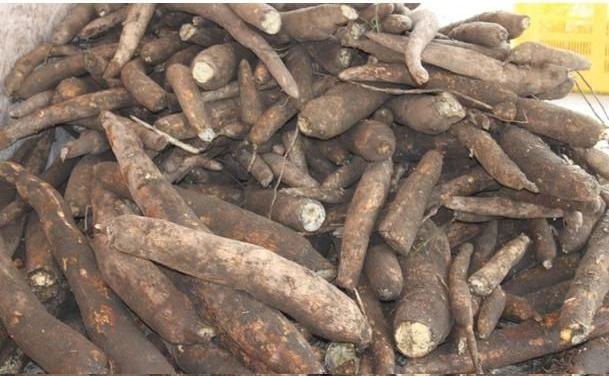

Harvested cassava tubers

Perhaps it was against this backdrop that President Goodluck Jonathan on November 30, 2011, introduced the cassava bread initiative as a component part of the Cassava Transformation Agenda. While presenting a sample cassava bread (made from 60 percent wheat flour and 40 percent cassava flour) to Nigerians at the Federal Executive Council meeting, the president said: “I have been eating this bread for the past one week and I will continue to eat only this bread until I leave State House. We must encourage what we have. Other countries that became great did not wake up one day and become great. If you look at the history of a country like China, at a time they closed their door and restructured everything, began to think again and by the time they opened their doors, the rest is known by all of us. For us as a nation to move forward, we must also tame our exotic taste. Some of these things we bring from outside are not even as good as what we even have within our country. And I believe with this, so many of the people who produce bread will start to use different percentages of cassava flour.”

He was right on point as through the new initiative, bakers in Nigeria are expected to supplement wheat flour with 40 percent locally-produced cassava flour in bread. The president has also shown some seriousness by following up the initiative with bold fiscal policies in the 2012 budget. These include raising the tariff on imported wheat, ban on importation of cassava flour, zero taxes on all equipment and machinery for processing high quality cassava flour and composite flours, 12 percent tax rebate for all producers of high quality cassava flour who attain the 40 percent substitution with high quality cassava flour, etc, which will take effect progressively. The government has further invited four major bakeries in the country – Wilson Foods and Confectionery Limited, Leventis, Food Concepts, and United Trading Company (UTC) Nigeria – to spearhead the production of cassava bread and other cassava flour-based confectionery.

Already, some stakeholders in cassava production are embracing the idea. For instance, the Association of Small Scale Agro Producers in Nigeria (ASSAPIN) promised to cooperate with the Federal Government to increase cassava production to complement government’s efforts. Also, the Federal Institute of Industrial Research, Oshodi ( FIIRO), Lagos, is already producing cassava bread in commercial quantity, beginning with only 10 percent cassava flour inclusion, which will be increased progressively until the 40 per cent target is achieved.

Others, however, are still skeptical given their bitter experience with such programmes in the past. Recall that in July 2002, the Obasanjo government inaugurated the Presidential Initiative on Cassava, which made compulsory 10 percent inclusion of cassava flour in wheat flour production, 10 percent blending of ethanol with premium motor spirit, and the use of cassava starch by industries. The initiative was expected to boost local industries involved in the processing of cassava products, generate about $5 billion annually via exports, and create employment. Farmers across the nation embraced it, and it also stirred the interest of entrepreneurs in cassava processing firms. But then, at the level of implementation, the initiative died, and both farmers and processors who embraced and invested in it with the hope of benefitting from its numerous advantages were left aground to count their losses. 


Adesina: Agric minister
 
The above fact does not, however, diminish the gains of a policy like the present one, most important of which is leading the way in Nigeria’s drive towards internal food-sufficiency. If cassava succeeds, attention can be shifted to other food crops like rice. Already, cassava is cultivated in every part of the country in very large quantities and, from statistics available from the Raw Materials Research and Development Council, Nigeria is the world’s largest producer of cassava, with a production capacity of 49 million metric tons – about 19 percent of world production. Nigeria can leverage on this comparative advantage, as did even smaller cassava-producing countries like Thailand, which capitalized on an export-led growth to become a major processor of cassava and exporter of cassava products, mainly to European Union countries. Today, Thailand is the world's largest processor of cassava – 40 million tonnes a year – mainly into vegetable starch.

But for this to work in Nigeria, government must device how to tackle the challenges currently faced by cassava farmers in the country such as lack of access to high yielding varieties, limited access to appropriate cassava processing technologies, and highly volatile price swings for cassava due to poorly developed markets; get the bakers to cooperate with government; build storage houses where cassava will be stored before it is transported to milling factories; convince consumers that cassava bread is as good as wheat bread; increase government’s budgetary allocation to agriculture from its present 2 percent; among others.

Finally, the government must be firm in implementing this policy, which has been described as “a make or mar policy that if well superintended could kick-start the liberation of the country from the woods”. I conclude with the words of Dupe Olatunbosun, professor of agricultural economics and former chairman of Ogun State Cassava Revolution Programme, thus: “The present administration should resist the blackmail of the wheat importers, majority of whom are the elite in the society. Nigeria will not collapse. It was Pandit Nehru, first prime minister of India, who said after India’s independence in 1948 that if India could not produce enough textiles to clothe its teeming population, she should go naked. Indian textile mills roared into action, churning out millions of yards of various designs of cloths. He also said if India could not feed herself, it was more honourable to die than to be dependent on another country before Indians could eat. That was the beginning of Indian grand agricultural industries.” This is the path Nigeria must toe if the current cassava initiative must succeed, and if the long-term dream of internal food-sufficiency must be achieved.

Tuesday, March 6, 2012

Okorocha dissolves Imo town union excos … As 4th tier govt election holds April 19


Ahead of the 4th tier government election billed for April 19, 2012 in Imo State, the state governor, Rochas Okorocha, has dissolved the executives of thea 357 town unions across the 27 local government areas of the state. 

When fully operational, the 4th tier government will attract unprecedented development to communities in the state, making Imo the most developed state in the country.

During a breakfast meeting with traditional rulers in the state at the Ahiajoku Centre, New Owerri, the governor said he dissolved the town union excos to pave way for a level playing ground for all the intending aspirants in the forthcoming election.

He urged Imolites interested in contesting for the available posts – president-general of community, community speaker, women leader, and youth leader – to kick-start their campaign, noting that Option A4 system of voting will be adopted for the polls.

While stressing that all traditional rulers in the state are expected to reside in their communities, Governor Okorocha directed all Imolites in the state government-owned primary, secondary and tertiary institutions to submit their names through a form to their traditional rulers who will then forward same to the government through the Ministry of Local Government.

Wednesday, February 22, 2012

Okorocha Denies Allegations Of Money Laundering

Okorocha: Imo State governor


Imo State governor, Owelle Rochas Anayo Okorocha, has described as unfounded the rumour peddled by some people that he was arrested in London by Metropolitan Police for money-laundering.
 
Gov Okorocha, who stated this while speaking with journalists at Sam Mbakwe Cargo Airport shortly on arrival from Abuja, said the rumour was orchestrated by the enemies of the state whose stock-in-trade is blackmail.

“The rumour circulated through SMS that I was quizzed in London over $10 million is unfounded and another blackmail by those who fought me during the electioneering period. They are the same people who at the wake of my election rumoured that I had stepped down,” Gov Okorocha said.

He explained that his mission in London was to sign a Memorandum of Understanding with a UK-based company to float a state government-owned airline that will be known as Imo Air.

While he attributed the rumour to the handiwork of some displaced individuals who are plotting to return to Government House through the back door, Gov. Okorocha enjoined the people of Imo State to remain calm and law-abiding even in the face of provocations as justice and fairness will prevail at the end of the day.

“I believe this latest attack on me is basically because of the judgment we are expecting at the Supreme Court. I have not seen where blackmail and rumour-mongering translate to mandate or victory. I have implicit confidence on the judiciary to dispense justice and fairness over the matter,” the governor concluded.

Thursday, February 16, 2012

Okorocha: Ohakim, PDP can’t truncate my mandate


Governor Rochas Okorocha of Imo State has expressed optimism
that the mandate given to him by Imo people will not be truncated by
the discredited former governor, Ikedi Ohakim, and some enemies of the
state in the Peoples’ Democratic Party, PDP.

The governor, in his reaction after adoption of briefs at the Supreme
Court in Abuja today, re-affirmed his commitment to transform Imo by
embarking on people-oriented projects and programmes.

Governor Okorocha also expressed his belief in the ability of the judiciary to deepen
democracy in Nigeria by upholding justice and fairness.

He urged Imo people to remain calm and law-abiding in the face
of falsehood, blackmail and provocation by Imo PDP and Ohakim.

Tuesday, February 7, 2012

Igbos: Suffering From Collective Amnesia?


By Chuks OLUIGBO

The other day I read a comment on facebook by someone I presume is a concerned Igbo person. It said: “I have said it several times, let Igbos leave the northern states and come back home. There are so many towns in the east where they can settle and do their businesses. They have the population which is an economic advantage. They can engage in manufacturing to cut down massive importation from China. Any Igbo who remains in the north chooses to commit suicide.” And I thought, with all the killings going on in parts of the North at the moment, is it possible that any Igbo person would actually wish to remain there? We will return to this later.

Igbo people, no doubt, are known to be among the most widely-spread and travelled ethnic groups in Africa. Today, there is hardly any part of the world that the Igbos are not found, so much so that it has been said that if men live in the moon, Igbos are there. In Nigeria, they are in a clear lead in internal migrations. They are seen in all other ethnic areas, even in the remotest parts, doing one business or the other and contributing to the socio-economic growth and development of their host communities.

This migratory trend among the Igbo will seem to have been going on long before colonialism. However, from the early years of colonial rule, Igbo migrations gathered momentum. The construction of roads and railways, the emergence of new urban centres in Nigeria, the establishment of cocoa farms in Yorubaland, the rise of Lagos as a major trading centre, the quest for Western education, the establishment of the Nigerian Civil Service and the attendant quest for white collar jobs were among the forces that pulled the Igbo out of their traditional homeland into other parts of Nigeria then. By the time of independence in 1960, many Igbo people from different communities had settled in various places outside Igboland. Writing in 1957, R. J. Harrison Church asserted that the “Ibo are found in temporary work all over Nigeria, and some 20,000 are employed in Fernando Po”.

This trend among the Igbo may seem to be an advantage, but it has also been a source of colossal loss to the people as they are jealoused and hated wherever they have found themselves in other parts of Nigeria, particularly in the North where they have been victims of several calculated attacks. The example below illustrates this point. In February-March 1964, during the sitting of the Northern House of Assembly, honourable members of the House variously urged the then Minister of Land and Survey, Alhaji Ibrahim Musa Cashash, to revoke all Certificates of Occupancy formerly issued to the Igbo people resident in the region; to stop the Igbo from building hotels in the region; to extend the application of Northernisation policy to petty-traders; to send the Igbo in the Post Office in the north back to Igboland; to repatriate all the Igbo working in the Civil Service of Northern Nigeria; to desist from awarding contracts to Igbo contractors in the North; and to give foreign firms in the North a deadline within which to replace all their Igbo staff with people from other ethnic groups.

The events of 1966-1970 – the Igbo genocide of May-October 1966, and the Nigeria/Biafra Civil War – therefore provided a vent for these pent-up grudges against the Igbo. These events severely affected the Igbo people, mostly those who were resident outside Igboland at the outbreak of the civil disturbances. In their hundreds and thousands, Igbo people scattered in all the nooks and crannies of Nigeria began to troop back to Igboland in search of a safe haven. The influx of refugees in Eastern Nigeria, from a conservative estimate, ranged between 1,000,000 and 1,200,000 from the North and half that number from the other two regions – the West and the Mid-west. The death toll is better explained by the assertion that “the resultant genocide is recorded to be second in magnitude only to the Jewish experience in Hitlerite Germany”.

The Igbo people who fled from other parts of Nigeria abandoned everything they had laboured for in the process. Most of those properties went with the war. In the minority areas of Eastern Nigeria, especially Port Harcourt, where 90 percent of the houses were said to belong to the Igbo, the governments of those states seized all Igbo belongings which they branded ‘abandoned property’. But the lessons of the civil war seem to have been lost on the Igbo. We shall elaborate on this later.

Since the end of the civil war, the intimidation, harassment, maiming and killing of the Igbo in the North have not ceased. The Igbo and their property have been the target whenever there are “religious riots” in the North. In many cases, the Igbo have been made to bear the brunt of conflicts among Northern groups and communities. Cases in point are the civil disturbances in some local government areas of Bauchi State between 20-24 April, 1991 in which many Igbo people were killed, despite the fact that the cause of the conflict had its roots in the age­long differences and disagreements between the Hausa/Fulani and the Sayawa ethnic groups of Tafawa Balewa L.G.A. The killing of the Igbo and other non-Muslims in the Sharia-motivated violence in the North in 1999 and thereafter is a further demonstration of this point of view.

Besides these killings, Igbo traders in the North are often made to pay discriminatory shop/store fees. Some state governments have also introduced discriminatory market and taxation policies against Igbo traders. In 1993, for instance, hundreds of Igbo traders in Kaduna took to the streets to protest against the imposition of prohibitive tax and business laws on them. Part of these laws required Igbo petty-traders to supply audited accounts, record of sales and evidences of remittances to the Board of Internal Revenue; original copies and photocopies of Pay-As-You-Earn (PAYE); with-holding tax, sales tax and entertainment tax. The protesting Igbo traders closed down their businesses in the metropolis and demanded a review of the obnoxious policies.

Igbo people in Lagos have equally faced similar bitter experiences. For instance, many Igbo traders who began to hawk electronics and allied products in Lagos and its environs at the end of the civil war were often harassed and their wares seized or vandalised by overzealous Yoruba officers and thugs. It was such intimidations that led them to found Alaba International Market. But even in this market, which was built solely by the Igbo, they are still constantly harassed and attacked. For example, in the 1993 demonstrations following the annulment of the June 12 presidential elections purportedly won by a Yoruba, Chief M.K.O. Abiola, Igbo traders at Alaba and in other parts of Lagos had their wares stolen or vandalised and many of them were attacked, maimed or killed.

In the past nine months or thereabouts, the North has again become a danger spot for the Igbos: first, following the post-election violence in parts of the North, and recently, following the Boko Haram bombings. The series of coordinated attacks on Christmas Day 2011 at some churches in the country left several people dead, many of them Igbo. The attacks continued on December 28, 2011, January 5, 2012 and January 26, 2012. In the first week of February 2012, Nigerian newspapers reported the pathetic story of the mass burial in Adazi-Nnukwu, Anambra State, of 13 Igbo victims of Boko Haram attacks. The victims, 12 men and a woman, were reportedly killed by gunmen in Mubi, Adamawa State, while planning for the burial of two of their own who had been killed in the earlier attacks.

Within the same week, Awhum community in Udi Local Council, Enugu State, received six corpses – Steven Offia (a panel beater and spare parts dealer in Yobe State), his wife (Nneka), their three children, and their house-maid. The victims were fleeing from their residence in Damaturu, the Yobe State capital, back to their hometown, Awhum, in a bid to escape Boko Haram’s bloody attacks when their car collided with a trailer coming from the opposite direction at Otukpa in Benue State. They were crushed to death by the trailer. Only the second son of the family, identified as Chibuzo, survived the crash, but he was said to be on the danger list at a hospital in Otukpa. These are just few examples.

Since the Boko Haram resurgence, a number of Igbo people and groups have been making frantic efforts to evacuate Igbos who are stranded in parts of the North. First, the chairman of G.U.O. Motors, Chief Godwin Ubaka Okeke, had taken the lead by sending 20 buses which successfully evacuated a number of Igbos from Maiduguri, the Bornu State capital, accompanied by heavy military escort. Some of the returnees also confirmed as at then that many more Igbos were still stranded in Maiduguri and that the killings were being carried out from house to house. Many too, especially corps members, were said to have been sleeping in the motor park for as long as 4 days, with no means to leave the state. Some Igbos who left on their own without escort were reportedly ambushed and killed on their way.

Also, on Thursday, February 2, 2012, over 150 Igbo citizens who were stranded in Maiduguri, Borno State, arrived at Ninth Mile Corner, Enugu three days after the same number of persons returned home due to the upsurge of Boko Haram activities in Northern Nigeria. The free luxury buses were provided by Igboville, a social network group of Igbo professionals in Nigeria and the Diaspora. Some of the returnees who spoke to reporters said they relocated to the bush for many days until they got hint of the free buses.

While receiving the returnees, founder of Igboville, Emeka Maduewusi, who spoke through Mrs Nelo Fina, implored them to quickly resettle in the South-East while the government sorted out the security situation. He called on the South-East governors to ensure that school children among the returnees were absorbed into different institutions in the zone and also pleaded with politicians and well-meaning Nigerians to assist in evacuating Ndigbo still left in the North from danger spots, adding that the evacuation of Igbo people would continue until every Igbo that is willing to leave is enabled to leave.

From all this, the pertinent question is: What, really, is wrong with the Igbo person? From all that the Igbo people suffered in other parts of Nigeria, especially in the North, in the immediate months preceding the civil war, and their harrowing experiences during and immediately after the war, who would have thought that they would ever go back to those areas where their brothers and sisters had been brutally massacred in their hundreds and thousands, and where they had been forced to abandon all that they had worked for barely a few years earlier? But that is exactly what has happened.

So, are the Igbo people suffering from collective amnesia? Is it possible to count how many Igbo lives that have been lost in riots in Northern Nigeria since 1953 when the first Igbo massacre occurred in Kano? Can anyone quantify in monetary terms Igbo investments destroyed in the North within the same period? How many times have the Igbo people been made to abandon all their belongings in other parts of Nigeria to seek safety in their homeland? How many times have they been evacuated from particularly the North? How many times more are they ready to face such evacuation? Why do they keep going back there? What is the attraction for them? Why would any Igbo person prefer to remain in a zone where he is hunted like game? What is in those areas that Igboland is lacking? How can these things be provided to bring the Igbo back to their homeland? How much longer will the Igbo people continue to develop swamps in the West and deserts in the North while Igboland continues to suffer gross undevelopment? What is wrong in developing Igboland and returning home to do business in Igboland?

For those Igbo investors who claim they are waiting for the South-East governors to create enabling environment in Igboland before they could go to invest in their homeland, what enabling environment did the Lagos governor create for you that you are so willing to acquire a swamp for N25m and sand-fill it with another N25m? What enabling environment did you find in the North where your investments are burnt down at the slightest provocation, and your life is not spared too? And for those who claim that they are attracted to Lagos, Kano and other parts of Nigeria because of the population there, how come you have not realised that you are the ones boosting the population of those areas? Have you not noticed how deserted a city like Lagos looks during Christmas when many Igbos travel home? Have you ever imagined what Igboland would be if half of the Igbo investments in Lagos alone were brought down to Igboland?

But there seems to be something fundamentally wrong with the Igbo person. I am tempted to call it foolish wisdom. It reminds me of this folktale in our childhood days about a sheep which had three children. She asked them one after the other: “How many times will something happen to you before you learn your lesson?” “Three times,” the first answered. “Two times,” answered the second. But the wisest of them all, Ebule Ako, said: “As it is happening to me that first time, I’m already learning my lesson.” True, a wise person does not strike his foot against the same stone twice. Unfortunately, while the Igbo people keep thinking they are wise, they have actually allowed the same stone to hurt them a million times. While claiming to be the proverbial Ebule Ako, they have in reality acted like the first two foolish sheep. No wonder Dim Chukwuemeka Odumegwu-Ojukwu, that great lover of the Igbo race, during his visit to Igbo traders at the Lagos Trade Fair Complex, addressed them as foolish goats. “Ewu kwenu!” he greeted them several times, because they had again allowed themselves to be used to develop from the scratch the three major markets at the complex – ASPMDA, Balogun and Progressive.

Ndigbo must at this point begin to think home. They must begin to internalise the age-old wisdom that east or west, home is the best, stop pursuing an ever-elusive pan-Nigerianism and invest at home. Unless they do this, they will continue to repeat the mistakes of the past, and Igboland will be worse for it.